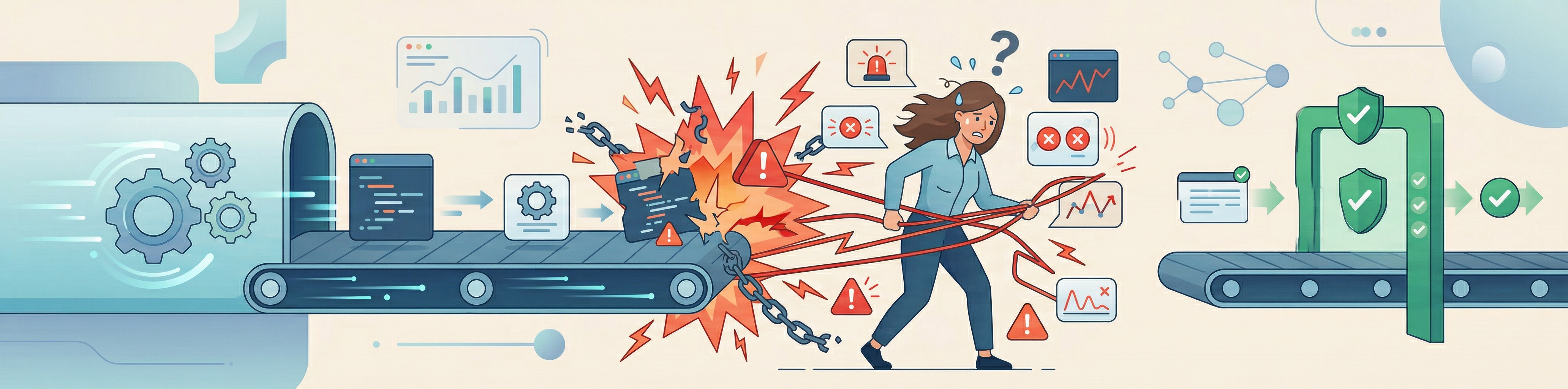
A healthy pipeline should say plainly: this change broke something or the environment is unhealthy. When for months you mostly hear “something failed again, just rerun,” you stop listening to the content of the message - you only hear the alarm sound. This post is about the cost of that numbness, especially for QA trying to understand real risk while the build keeps crying wolf.
Symptoms you have seen in postmortems
You usually do not have to look far:
- Randomness - the same job passes four times in a row, then fails on a step “nobody touched.”
- Retry as policy - instead of diagnosis there is a playbook: “wait five minutes and click again.”
- No owner for red - the
#buildschannel glows red and the thread ends at “works on my machine” or “that’s infra.” - Jokes instead of action - “CI roulette,” “Mercury retrograde” - humor hides the fact that people no longer believe red means something.
That is not only developer frustration. It is a broken information channel, the same channel many teams use to say “main is healthy.”
A cost larger than retry minutes
The first cost is obvious: rerun time, merge blocking, waiting for an environment slot.
The second cost is quieter: endless triage. Someone reads the log, decides “same timeout again,” links last month’s ticket, and goes back to the PR they were supposed to scope. Each loop steals attention you cannot buy back with a faster machine.
The third cost is normalized red. When most alerts are noise, people stop treating every red build as a reason to pause. Then you get merges “because it is usually flaky” - and a real regression looks like another false alarm until it shows up in production.
For QA that is a double load: you still need to understand the change (see the post on PR context and scope), and you must filter pipeline noise to know whether exploratory work even makes sense right now.
Missed edge cases as a system story
When something breaks in production it is tempting to look for a “missing test case.” Often a simpler mechanism is closer to the truth:
- Thin understanding of the change - because the day went to the fifth retry and the fifth debate about whether the test environment has the right config.
- An exhausted attention budget - after three false alarms it is harder to do deep thinking about feature boundaries.
- System edges - integrations, auth, queues, test data, time zones - where one assumed “obvious” fact is false.
It is not always “low coverage.” Often it is signal drowned by noise - and retrospectives should treat that as seriously as coverage numbers.
What to fix first - order matters
A sensible order usually looks like this:
- Split signal from noise - before you add tests, agree which reds actually speak to change quality versus unstable infra, data, or known flakes.
- Stabilize or isolate - a flaky suite that blocks every PR should be fixed or labeled and separated so it does not pretend to be the quality gate on
main. - Ownership and SLA - who responds to red on
main, how fast, when to escalate - without that you return to “everyone watches, nobody clicks.”
Here is a table you can paste into team notes:
| Symptom | Typical root cause | Sensible first step |
|---|---|---|
| Same step fails “randomly” | Race, timeout, external dependency, dirty data | Reproducible logs, minimal repro, timeouts and bounded retries |
| Fails only on CI, not locally | Environment drift, secrets, resources | Compare envs, explicit CI assumptions |
| Fails after someone else’s merge | Test coupling, shared account, ordering | Data isolation, job queueing, dependency review |
| Same team always “fixes the build” | No ownership rotation | Clear step owner + rotation or runbook |
This does not replace debugging, but it stops the team from stacking tests on a foundation that already cracks.
Metrics that actually say something (even rough ones)
You do not need a dashboard on day one. For two weeks, track manually:
- What share of red builds on
mainend as “known flake / environment” instead of “real defect”? If that is most of them, the problem is not coverage - it is signal credibility. - Median minutes from red to decision (retry, fix, revert)? A rising median often means missing ownership, not “hard bugs.”
- How often does QA interrupt PR analysis for an “urgent” build? That is the direct bridge to the hidden tax on understanding each change.
Closing
If CI is a meme on your team, the answer is rarely “buy more tests” alone. You usually need cleaner pipeline signal and a short, shared picture of the change before you run everything - otherwise you add execution minutes on top of a foundation full of false alarms.
The goal is not a green build one hundred percent of the time. The goal is that when it is red, the team trusts it matters - and QA can budget time to understand scope instead of fighting another fire that was mostly noise.